The VHC Blog
This blog is meant as a discussion forum for participants in the Y-DNA project the Värmland-Hedmark Cluster. The blog will also be used to post news and general information about the project, as a complement to the newsletter that comes out now and then.
The oil painting pictured on the left is from 1924 and shows the ferry across the river Klarälven in Ransäter, Värmland. The artist is Gumme Åkermark (1847-1927). Source: Värmlands Museum (public domain mark 1.0).
|
The December 2024 issue (No. 12) of the Värmland-Hedmark Cluster newsletter has now been published. See here: www.johanlagerlof.com/uploads/2/9/8/4/29840707/vhc-newsletter-dec-2024-v1-reduced.pdf
4 Comments
A new issue of the newsletter is published! It can be found here.
Among other things, I write about Family Tree DNA's assignment of Y-DNA haplogroups based on autosomal tests. If you have by FTDNA been assigned the Y-DNA haplogroup R-ZP30, then there is a decent chance that you belong to the Värmland-Hedmark Cluster. If you indeed have been assigned R-ZP30, then please get in contact with me. You can also find more information in the newsletter, but you should still --- please -- get in contact with me. Thank you! I have now finished the new issue of the newsletter The Värmland-Hedmark Cluster. On this occasion I could do that one day ahead of my self-imposed deadline (end of July). A bigger margin than usual!
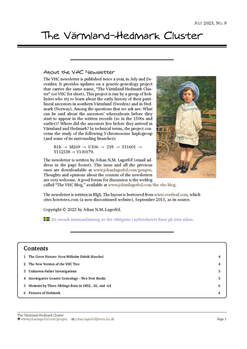
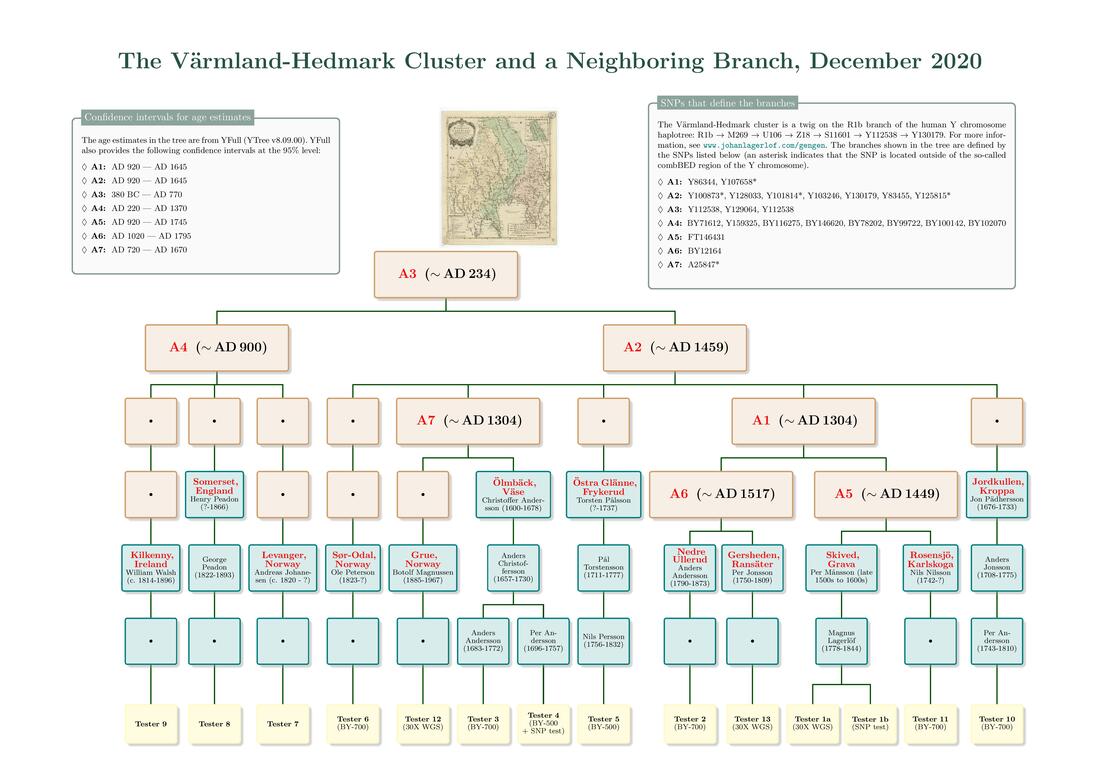
Many of you might not have a strong enough interest to read the newsletter. But if you are a little bit interested, I recommend having a look at the new version of the tree (included on page 2; also available in a separate file). Studying the tree for a while is a quick way of getting an impression of how the project develops. Also, for those of you who read Swedish, there is a summary in that language on the last page. Please consider doing some advanced Y-DNA testing yourself (if not having a Y chromosome, one can test a relative – or an unrelated friend). The headings of the newsletter serve as a good indication of its content:
The new issue is downloadable from this link: www.johanlagerlof.com/uploads/2/9/8/4/29840707/vhc-newsletter-july-2023-v1-reduced.pdf The content of the newsletter can be summarized by listing the headings of its four sections:
The new issue is downloadable from this link: https://www.johanlagerlof.com/uploads/2/9/8/4/29840707/vhc-newsletter-dec-2022-v1-optmzd.pdf I have now published the July 2022 issue of the newsletter. The content of the newsletter can be summarized by listing the headings of its four sections (see below). The issue can be downloaded here.
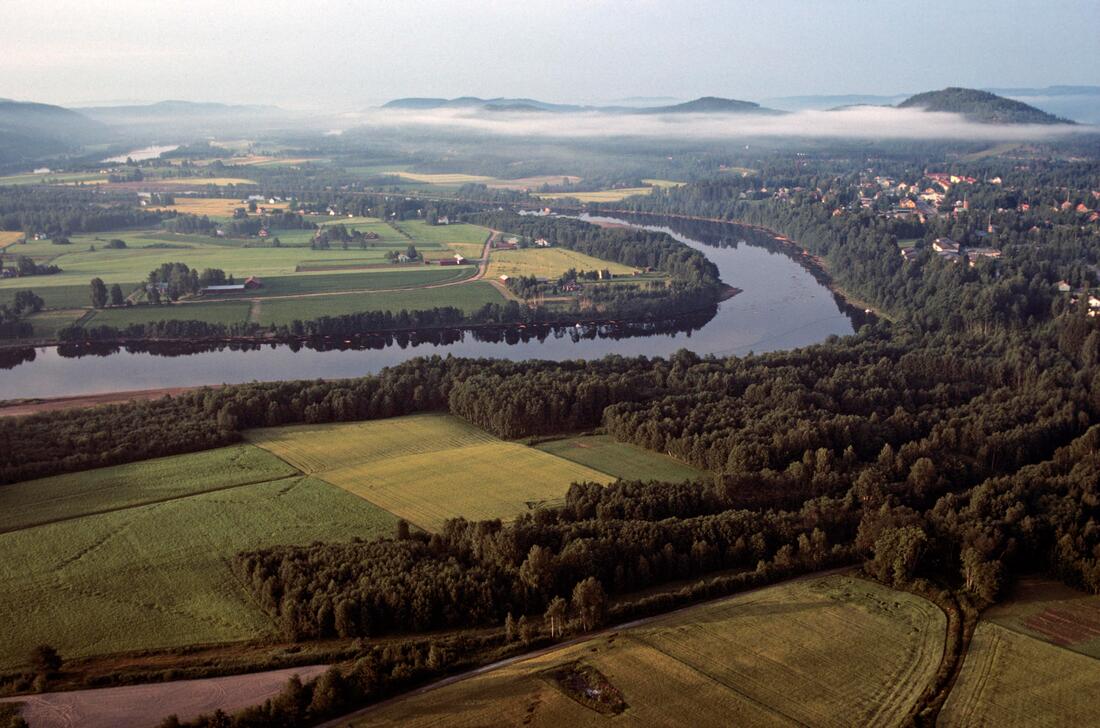
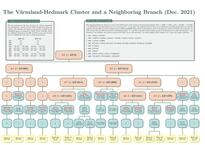
The photograph below and to the right is used as cover picture for the issue. It shows the river Klarälven and Haraudden, just north of Ekshärad. The photograph was taken by Pål-Nils Nilsson (1929-2002) and is part of the collections of Riksantikvarieämbetet. There is no date indicated, but Riksantikvarieämbetet writes on its website that most of the digitized photos by Nilsson in the archive are from the 1970s and 1980s. Somewhat delayed, I can now publish the December 2021 issue of the newsletter. The content of the newsletter can be summarized by listing the headings of its six sections (see below). The issue can be downloaded here.
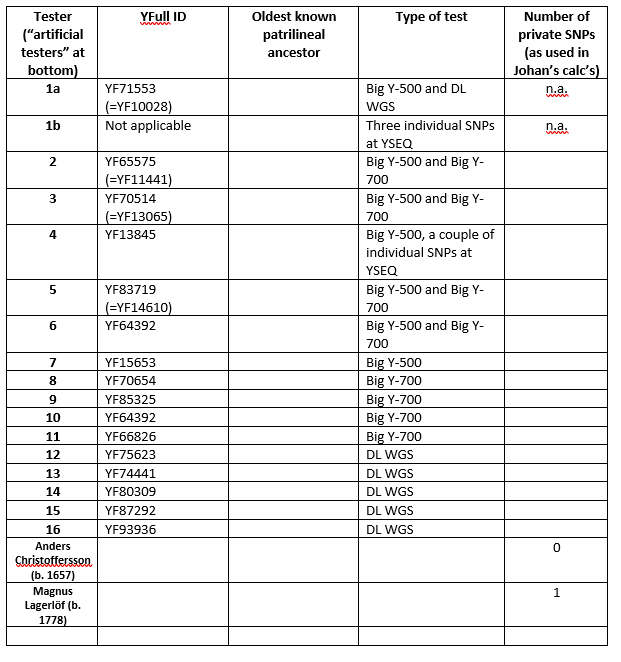
EDIT: I here add a screenshot of a table that shows the connection between YFull IDs and the number of the testers used in the newsletter. This is in response to a question from Bruno (see below). It does not apper to be possible to put pictures or other things in the comments, so I do it here instead.
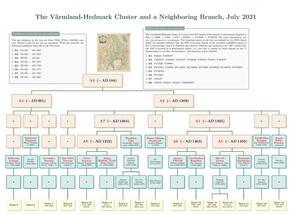
Now the No. 5 (July 2021) issue of the Värmland-Hedmark cluster is published. It can be downloaded here.
From one of the project participants, I received the comment that I have copied in below. The background is that I, in the newsletter (No. 4, p. 9), was agnostic about the direction of the migration between Scandinavia and the British Isles.
“As I read your hypotheses, I thought I would respond on one point. The subclades of our genetics are very rare in Ireland. Even U106, a fairly ancient and widespread subclade, only represents 6% of Ireland’s population. The downstream mutations from U106 are even rarer. The hypothesis related to our genes originating from Ireland would be a very small probability. I believe the probability the subclades originated in Scandinavia is very high. Based on FTDNA data, our downstream subclades were heavily involved in the colonization of East Anglia and Cumberland within the British Isles. In Normandy, we settled late (around 1025 ad.) in the Cotentin Peninsula. There was a genetic survey done by the U of Rouen which concluded the population in the Cotentin was from Denmark by way of Ireland. In 1014, Brian Boru defeated the Hiberno-Norse in Ireland at Contarf. Many left and emigrated to the wild west of Normandy, wrestling the land away from the Bretons. As I mentioned, the names in Scandinavia have a perceptible Irish influence (Nial, Pers, etc).” Reading this, I realize that I have been unclear about one thing in the newsletter: When I talk about the possibility that the ancestors A3 and A4 lived on the British Isles, as opposed to Scandinavia, that does not amount to a claim that no one of A3’s ancestors lived in Scandinavia. That is, hypotheses H2a-c in the newsletter are fully consistent with, for example, the SNP Z18 (which is upstream of A3 and downstream of the SNP U106) having its origin in Scandinavia. The ancestor A3 lived relatively recently (380 BC – AD 770), whereas the SNP Z18 is estimated to have occurred much earlier than that (4300 BC – 3300 BC). Indeed, the evidence that we have available seems to indicate that, for certain lineages, there have been multiple migrations, back and forth, between Scandinavia and the British Isles. One can see that by looking further upstream in the trees at YFull and FTDNA. The pattern of self-reported country flags suggests that migration between Scandinavia and the British Isles (in either direction) occurred also before A3 lived – to see this, look, for example, at FTDNA’s block tree at the level of R-S11601 or R-ZP30 (the two steps immediately upstream of R-ZP144). So, I note that the data seem to show that, within the lineages we talk about, there were migrations between Scandinavia and the British Isles both before and after A3 lived. I also note that there are plausible stories for how migration from the British Isles to Scandinavia might have occurred (like timber trade, Vikings bringing back slaves, or Christian missionaries). I then conclude from those observations that I cannot rule out the possibility that A3 lived somewhere on the British Isles. That is, I choose to be agnostic about whether he lived on the British Isles or in Scandinavia (so not a particularly strong claim). Known errors in No. 4 of the newsletter (last update: July 28, 2021):
I have also found some other typos and language issues, but as I don’t think they are likely to create misunderstandings, I will not bother to list them here. |
Johan N. M. LagerlöfThis is a blog about a Y-DNA project called the Värmland-Hedmark Cluster. For some more information about the project, look here. Archives
January 2025
Categories |


RSS Feed